PCMCIA RS-422/485 Serial Communications Card
Features
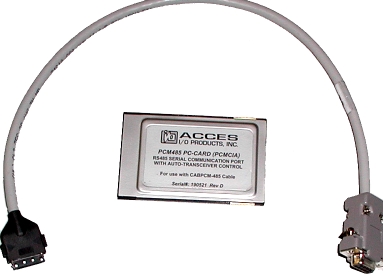
- Type II PCMCIA Card
- Plug-N-Play Windows Installation
- Asynchronous RS-485 or RS-422 Serial Port
- Type 16550 16-Byte Buffered UART
- Baud Rates to 115Kbaud
- Automatic Send-Data Control for Windows Compatibility
- Extended AT Interrupts (2-7, 10-12, 14 & 15)
- DB-9 Male Connector via cable adaptor
- Cable connector compatible with COM-2S and ICOM-2S ports
INTRODUCING PCMCIA
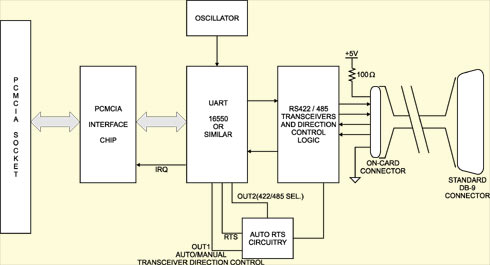
The PCM485 is a multi-protocol serial card that supports RS-422 or RS-485 communications in a single 5V PCMCIA Type II card. The PCM485 uses a crystal controlled oscillator which permits precise selection of baud rates from 50 to 115,200.
The output transceiver used, the MAXIM 485, is capable of driving extremely long communication lines at high baud rates. It can drive up to 60mA on balanced lines with a quiescent current of 300 uA. It can receive inputs as low as 200mV differential signal superimposed on common mode noise of maximum 60 V. In case of communication conflict, the transceivers feature thermal shutdown.
COMMUNICATION MODES
Model PCM485 supports Simplex, Half-Duplex, and Full-Duplex communications in a variety of 2- and 4-wire cable connections. Simplex is the simplest form of communications with transmissions occurring only in one direction. Half-Duplex allows traffic to travel in both directions, but only one at a time. And Full-Duplex has data traveling in both directions at the same time. RS-485 communication only supports half-duplex because the same pair of signal lines are used for transmitting and receiving.
AUTO AND MANUAL TRANSCEIVER CONTROL
RS-485 communications requires the transmitter driver to be enabled and disabled as needed to allow up to 32 cards to share a communications line. The PCM485 card has two methods of controlling the driver; automatic (AUTO) and request to send (RTS) control. With automatic control, the UART is normally in the receive mode. When data are ready to be transmitted, the driver is enabled. The driver remains enabled for the transmission time of one character after data transfer is complete and then the card reverts to the receive mode. The PCM485 automatically adjusts it's timing to the baud rate of the data.
CARD AND SOCKET SERVICES
PCMCIA Card and Socket services must be loaded on the host computer system before using the PCM485 card and is typically supplied by the PCMCIA slot provider (the laptop or adaptor manufacturer) to provide the software interface to the card slot drive. In addition, our TSR memory-resident program, described below, is required to configure the card once it is recognized by the card and socket services.
The Card and Socket services handle the PCMCIA slot software interface with your operating system when a new card is inserted (or removed) or when power is applied (or upon shut-down). Once the PCMCIA slot recognizes the PCM485 card it then appears to your application software like a card on the internal ISA bus.
Return to top of page
Specifications
Return to Product Description
Communications Interface
- Multipoint: Compatible with RS-422 and RS-485 specifications. Serial communications UART used is type 16550. Transceivers used are type MAXIM485 and Motorola type MC34051 (for RS-422 transmission only).
- Serial Ports: Cable adaptors provide compatibility with COM-2S, ICOM-2S, and other popular connection formats. Three versions available.
- RS-485 Drive: A total of 32 transmitters and receivers allowed on one line.
- Receiver Input Sensitivity: 200 mV, differential input.
- Transmitter Output Drive Capability: 60 mA (100 mA short-circuit current capability).
- Serial Data Rates: 50 to 115,200 baud. Asynchronous.
- Address: Continuously mappable within 100 to 3FF (hex) range of AT I/O bus addresses.
- Interrupt: Selectable for any available IRQ from 2-7, 10-12, 14, and 15.
Environmental
- Operating Temperature Range: 0 to 60oC
- Storage Temperature Range: -50 to 120oC
- Humidity: 5% to 95%, non-condensing.
- Power Required: 5mA, 5 VDC (at standby) Load drive currentis added.
- Size: Type II PCMCIA card slot.
Regulatory Compliance  Declaration of Conformity, and Test Reports are on file. Users must use appropriate shielded cables. Declaration of Conformity, and Test Reports are on file. Users must use appropriate shielded cables.
| Part Number |
Price(USD) |
| PCM485 |
call us |
View / Download Manual (in .pdf format)
Return to top
Acquisition Control Communications Engineering / Systems |